

Semantic Modelling: The Foundation of Outcome-First Cognitive Buildings
The leap from an integrated building to a truly cognitive one is impossible without a standardised layer of logic. This article explores how semantic modelling acts as the foundation for AI-driven performance, ensuring your digital asset provides long-term value instead of decaying the moment construction ends.

Semantic modelling is the essential foundation for any building that aims to move beyond simple automation and into real-world intelligence. It is the framework that allows us to turn a collection of disconnected data points into a meaningful digital asset. While the industry often gets caught up in the over-complication of roles and enablement practices, the real value lies in defining the relationships between systems. This structure is what allows us to run the advanced analytics and artificial intelligence that the modern built environment requires.
To deliver this successfully, we believe in a move away from a traditional construction-led approach, which focuses purely on the delivery of tech, and instead adopt a right-to-left mindset. This means starting with the final operational outcome—such as reducing a maintenance backlog, improving clinical performance, or improving occupier experience—and designing the digital logic backwards from there. Semantic modelling acts as the solution to the triple detachment where design, delivery, and operations often become completely disconnected.
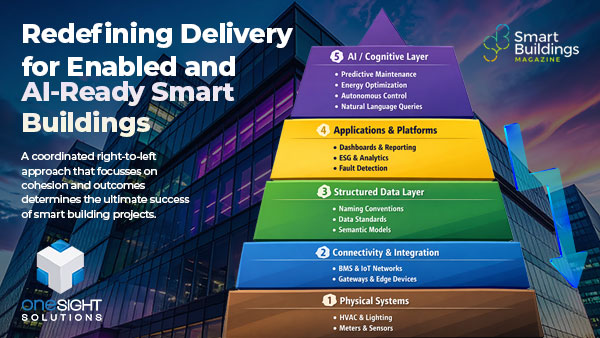
To understand how to derive this value, we’ve looked at creating a digital pyramid for a building. This shows the progression from basic connectivity to an environment that can think for itself.
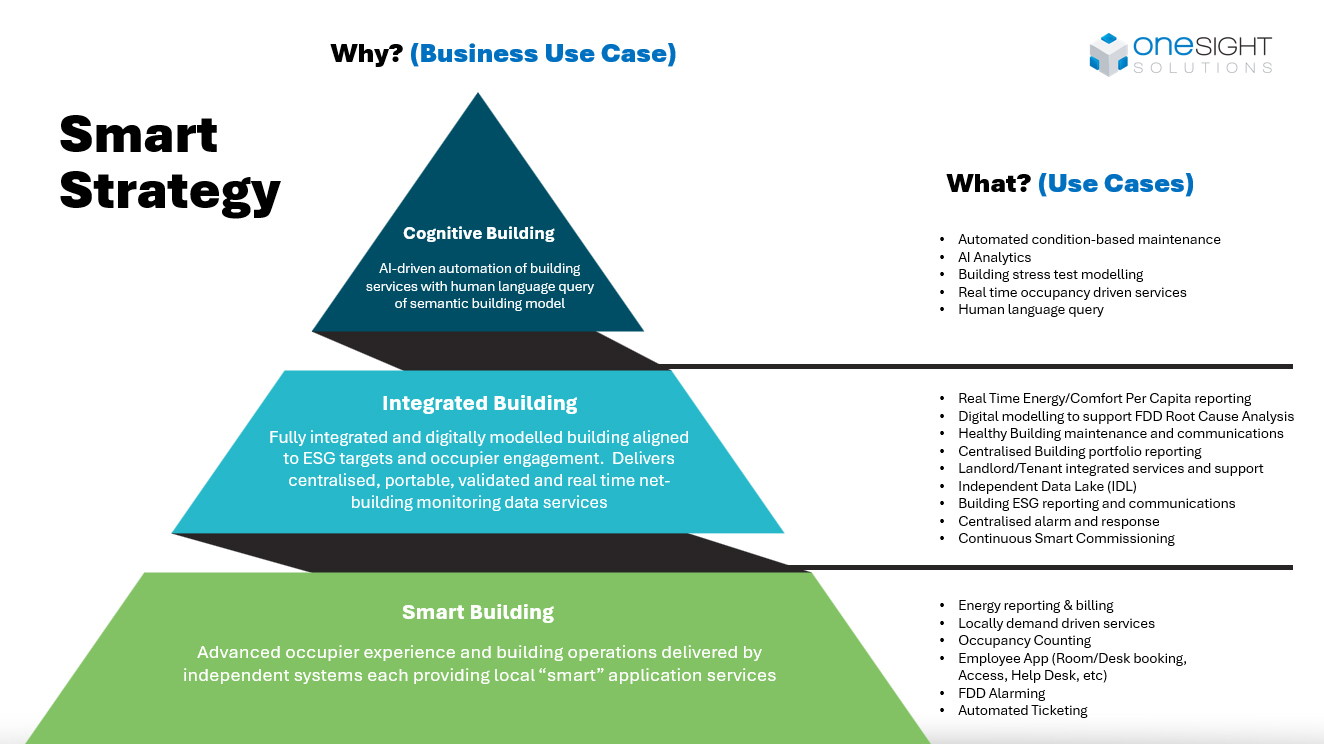
The Building’s Digital Pyramid
Most modern projects successfully manage the first two layers of this pyramid, but they often struggle to reach the final stage because the data lacks structure. For the building to stay efficient long after the construction team has left, we need to focus on how this data supports the people running the building every day.
Starting with the Smart Building Layer is the base level and foundation for most modern buildings. It involves independent, intelligent systems such as building management systems, lighting controls, and room booking tools. These provide essential services and basic automation, such as occupancy-based lighting or demand-driven heating and cooling. At this level, we get smart alarming and basic fault detection, as well as occupancy counting to provide demand-driven services. These systems do a great job of providing local automation, but they generally sit in their own silos, meaning the data is not yet working together as a single asset.
Operationally, this layer provides the basic tools for the maintenance team to react to issues. However, because these systems generally sit in their own silos, the data is not yet working together as a single asset. At the point of handover, this often leads to a disjointed experience where the facilities team has to jump between different screens and manuals to manage each trade separately, making it difficult to get a clear picture of building health.
Next we get the Integrated Building Layer. This stage focuses on live data and validation. Systems are modelled and aligned with environmental, social, and governance targets. This allows for real-time reporting for standards like NABERS and ensures that data is centralised and made available for continuous commissioning. This layer is about making data portable and centralised, often referred to as an independent data layer. It allows for real-time reporting on metrics like comfort per capita and energy use, all underpinned by continuous smart commissioning to ensure the building is actually performing as intended.
The benefit here for ongoing servicing is that it prevents the information decay that usually happens after handover. In many construction-led projects, the digital asset begins to degrade the moment the contractor leaves because the system logic is not maintained. By centralising and validating data in an independent data layer, we ensure the building is actually performing as intended on day two and beyond. For the public sector, such as the NHS, this layer is critical for beginning to arrest the maintenance backlog by providing real-time monitoring that actually meets strict compliance and energy targets.
Lastly, we’re at the Cognitive Building Layer. It is an environment where the building can reason and automate complex tasks using artificial intelligence. This stage moves into full AI reasoning and is capable of AI-driven automation and generative design. Here, you can use large language models to query the building data using natural language, essentially just asking the building how it is performing in plain English. However, this is only possible if the building has a semantic layer to explain how its data relates to the physical world. Without that digital map to provide the logic, the AI has no way of understanding the relationships between the systems it is trying to manage.
In terms of ongoing service, this layer is about providing diagnostic velocity. This is the difference between a technician spending hours trying to find a fault and an AI-assisted system pointing them to the exact valve or sensor that needs fixing in minutes. This turns the building into a performance twin, where the focus shifts from just keeping the plant running to supporting the actual mission of the building—whether that is improving occupant experience or ensuring a clinical ward stays open. However, this is only possible if the building has a semantic layer to explain how its data relates to the physical world.
Turning Data into Logic
The move from an integrated building to one that is truly cognitive is impossible without semantic modelling. Most buildings currently generate a chaotic mix of cryptic labels where a sensor named AHU_01_TMP means nothing to an AI engine without context. Simply gathering this data is not enough; to run proper analytics or fault detection, the system must understand the building topology—the physical relationships between different pieces of equipment.
Semantic modelling adds a standardised layer of metadata that describes not just what a thing is, but its relationships to other things. Whether using tagging systems like Project Haystack or ontologies such as Brick Schema or RealEstateCore, this process creates a digital map that allows software to navigate the building systems autonomously. To provide meaningful value for the operational team, the data structure needs to show:
- Which air handling unit serves which specific floor or zone.
- Which meters feed which specific items of plant.
- How an occupancy sensor in a room relates to the air valve providing its ventilation.
This digital map provides the context that tells an AI engine that a specific sensor is not just a random number, but a critical piece of a wider system. Without this layer, we are limited to simple cause-and-effect rules that have been available in standard systems for decades. For the engineers taking over at handover, having this logic in place is what turns a list of points into a functional tool for managing the building’s performance.
Operational Survival
The real-world value of this digital map is diagnostic velocity. In a critical environment like a hospital, the difference between a two-hour and a two-minute diagnostic window can be the difference between a functioning ward and a cancelled surgical list.
Semantic modelling provides the immediate context needed to know exactly which valve or meter is failing and exactly which clinical area it impacts. This allows a maintenance backlog to be managed by the priority of clinical outcomes, rather than just a chronological list of faults.
We must also address the risk of information decay. In many construction-led projects, the digital asset begins to degrade the moment the contractor hands it over because the semantic links are not maintained. Without a standardised foundation like Brick or Haystack, the digital intelligence of a building quickly reverts to a series of disconnected, dumb silos as systems are repaired or replaced. For a performance twin to succeed, the logic map must be part of the operational DNA of the building.
The Specification Gap
The reason many buildings can fail to reach the cognitive layer is often due to a disconnect in the design phase. Consultants generally produce two types of specifications, both of which can miss the technical links required for advanced intelligence.
The first is the experience-led specification. These are often aspirational and focus on how a user might find a desk or adjust their local environment. While they provide a clear vision, they rarely explain the technical pathway to achieve it. For example, a lighting specification may not include the specific integration requirements needed to make a user app function.
The second is the technical-led specification. These focus on a granular list of equipment and points. The risk here is data noise—collecting thousands of points without defining why they are needed. You can end up with a vast amount of irrelevant information while missing the specific diagnostic data required to drive real results.
Crucially, both types of specifications often suffer from a lack of engagement with the people who have to run the building: the operational teams. Because these documents are written for the construction phase, they are frequently too focused on management reporting. While high-level dashboards for ESG or energy ratings are important, the benefits of the technology need to trickle down to the ward floor or the plant room.
If a smart system is designed solely to give the board a monthly report but does not help a maintenance engineer identify a failing pump in real-time, it is not providing true operational value. By leaving the operations team out of the initial design conversation, we miss the practical requirements needed for the building to function efficiently on day two and beyond. Success requires a bridge between management’s need for data and the engineer’s need for diagnostic utility.
Deskilling the Digital Foundation
A major hurdle to adopting these standards is that semantic modelling has traditionally been seen as a job for data scientists using complex coding tools. If we want this to work in the real world, we have to deskill the process so it can be handled by the engineers taking over the building at handover. This is the exact point where the triple detachment usually happens. In most construction-led projects, the digital asset starts to degrade the moment the contractor leaves because the maintenance team lacks the specialised skills or tools to manage the underlying data logic.
For a performance twin to actually last, the operational engineers need simple, visual tools that allow them to maintain these semantic links without needing to be coders. These engineers are experts in mechanical and electrical systems, not software development, so the technology needs to speak their language.
This shift is very similar to how web design changed in the early nineties. At the start, you had to be a programmer to build a website, but then visual tools came along that let anyone do it. We are starting to see this now with frameworks like Niagara and systems like KNX, which are building modelling capabilities directly into the tools that engineers use every day. By standardising how we model the building and making these tools accessible to the operational team, we ensure the digital logic survives the handover. Only then can we move past basic alerts and create buildings that offer the long-term predictive power that modern technology promises.
Authors:
John Clarke – Operations Director, One Sightsolutions