
MSI & Smart Enablement
Redefining Delivery for Cordinated IoT & AI-Enabled Buildings
● Updated on Mar 31, 2026
● 15 min read


Redefining Delivery for Coordinated IoT-Enabled and AI-Ready Smart Building Outcomes
The smart building sector has evolved rapidly, but its delivery model hasn’t always kept pace. Today, the industry is saturated with various labels: Master Systems Integrator (MSI), Software Systems Integrator (SSI), Platform Provider, Digital Main Contractor, Intelligent Building Contractor being just some of these. While these titles aim to define leadership, they often blur responsibilities rather than clarify them.

The Problem with Catch-all Terminology
There is a growing question of why so many distinct terms are necessary. In reality, different buildings and clients require different roles, and searching for a single catch-all term ignores the bespoke nature of modern projects.
Many organisations claiming integration leadership still operate through the lens of their origin—whether that is controls, IT infrastructure, AV, or software. This means no single perspective is entirely complete. When procurement and system logic are tied to the same commercial incentives, often the original operational intent can be diluted by delivery and contractual pressure.
Bridging the Gap through Coordination
A recurring challenge we see is the lack of technical cohesion during the consultancy and design phases. Smart consultants often focus on high-level client aspirations or use cases rather than the granular operational and technical outcomes required for true functionality. While these vision-setting workshops are vital, the resulting specifications frequently lack the depth needed to address specific hardware, software, and integration points. Not that this is always a fault of the consultancy teams, as they again will be tied to commercial and scope constraints.
When a project moves to delivery, complexity increases as multiple moving parts must be coordinated across siloed workstreams. This involves reconciling various specifications for M&E (Mechanical & Electrical), ICT (Information and Communication Technology), and BIM (Building Information Modelling), all while accounting for how the building will be managed.
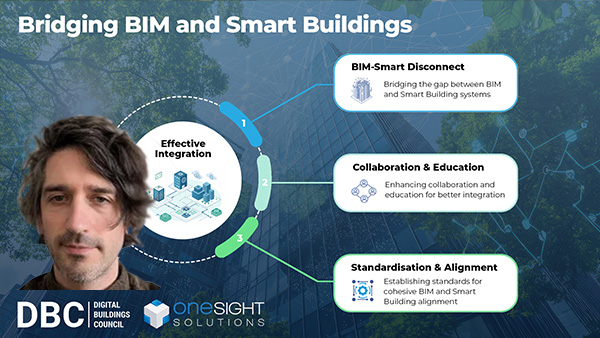
This complexity creates a clear need for a dedicated coordination role—a function often referred to lately as the Master Systems Coordinator (MSC). While this specific title is being talked about more frequently of late, as I mentioned at the start, the name on the contract is far less important than the intent behind the work. Fundamentally, this is about having a technical bridge between design and execution to ensure that digital logic—such as naming conventions, data standards, and communication protocols—remains consistent across all trades.
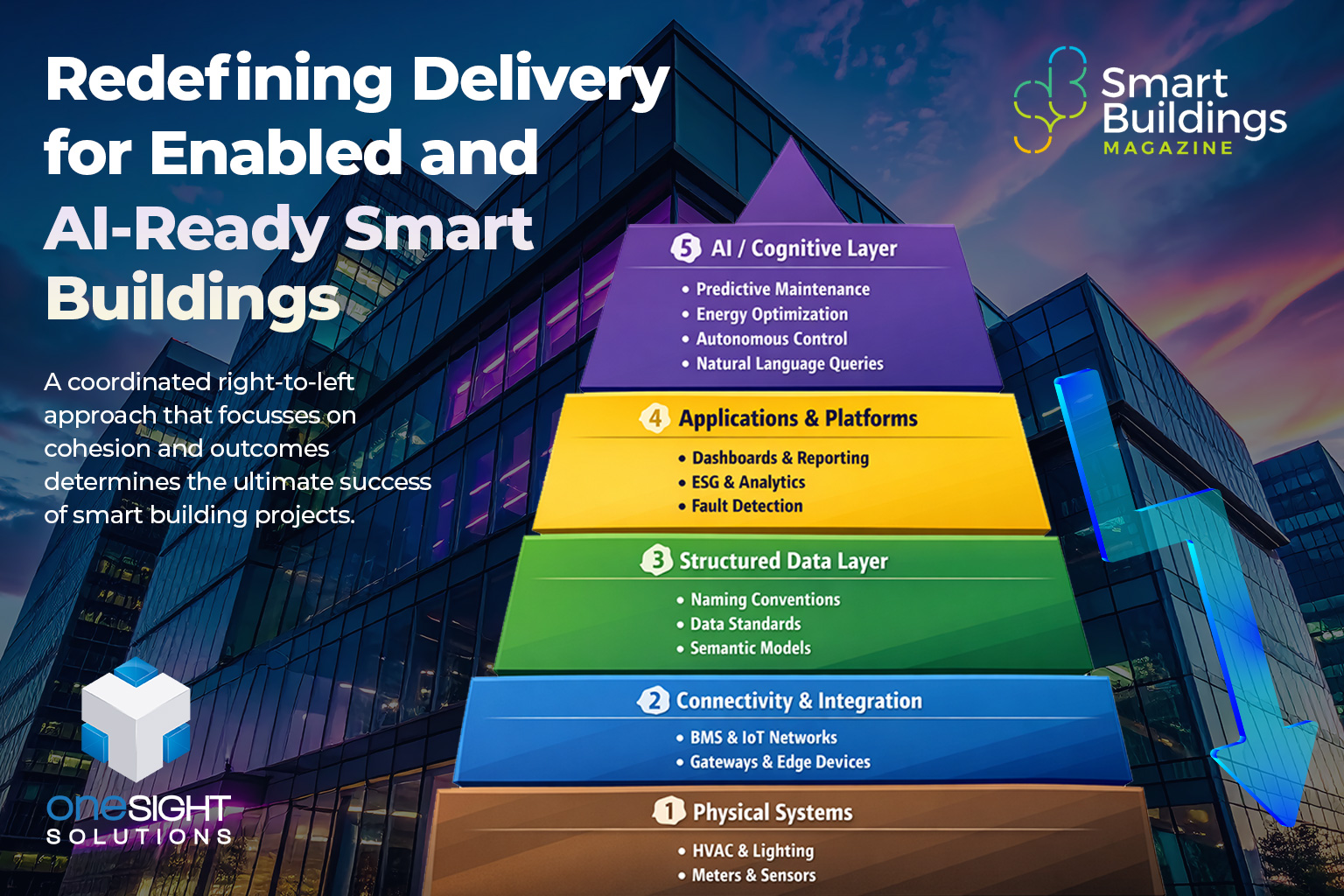
Ultimately, success doesn’t come from a label; it comes from having good people with the client’s best interests in mind. You need a partner who is focused on the actual outcome, capable of catching potential gotchas before they become expensive late-stage problems.
The Value of a partner working as a “Master Systems Coordinator”
- A more effective approach is to move beyond technical coordination and introduce operational stress-testing, bringing real Day 2 insight into the design phase to ensure systems meet the data demands of modern applications and users.
- Clarity in delivery comes from separating governance from execution—defining the logic, standards and data structures upfront, while allowing delivery teams to focus on efficient installation and integration.
- Increasingly, mature smart building clients are recognising the need for this approach, understanding that strong digital governance is essential to ensure their buildings can support long-term operational platforms and evolving data requirements.
The Trap of the Application-First Approach
It is common for projects to adopt an application-first mindset, prioritising specific software solutions because they appear to be the quickest route to a smart label. However, this often results in vendor lock-in, where the end-user lacks true ownership and flexibility over their building data.
True ownership requires that the client retains data in an open, standardised format, decoupled from the specific software layer. This allows you to switch providers or applications without losing functionality or historical data.
The Need for Meaningful Integration
While Open Protocol is often used as a benchmark for quality and modernisation, merely being technically open does not guarantee the best method for integration. Relying solely on a protocol’s certified label can lead to headaches if the specific features required for a use case are optional or poorly implemented by the manufacturer or integrator.
For example, a device may support an open standard but fail to expose the critical diagnostic data needed for automated maintenance. Flexibility is paramount; the goal should be the integration method that provides the most efficient and scalable path to a usable outcome, rather than just checking a box for a specific protocol.
From Smart to Cognitive
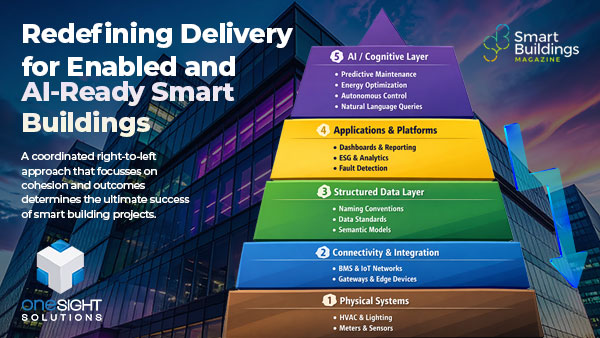
To understand the long-term value of a building, the journey can be viewed through three distinct layers:
- Smart Building – Independent systems providing local services to improve occupier experience and basic operations.
- Integrated Building – A more mature stage where systems are digitally modelled and aligned to ESG targets, delivering centralised, portable, and validated real-time data.
- Cognitive Building – The pinnacle of this evolution, featuring AI-driven automation and human-language querying of the building’s data.
The Future of Smart – A Foundation for AI
There is a significant drive towards integrating AI into the built environment. We are promised buildings that can self-optimise, predict failures before they happen, and even hold a conversation with facility managers. However, there is a fundamental reality check the industry often overlooks: AI is only as useful as the data it can understand.
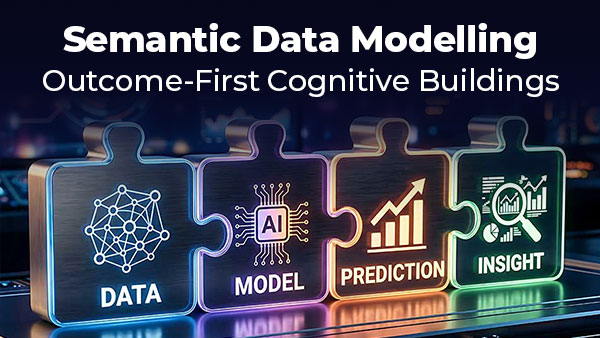
Semantic Modelling
Currently, most building data is a chaotic mix of cryptic labels and siloed databases. An AI engine might see a data point labelled AHU_01_TMP, but without context, it doesn’t know if that is a room temperature, a setpoint, or a discharge air sensor. It certainly doesn’t know which rooms that unit serves or how it relates to the wider floor.
Think of a semantic model as a digital map for the building’s brain. Just as a driver needs a map to understand how streets connect to reach a destination, an AI needs this model to understand how one system connects to another. Without it, the AI is essentially lost in a dark room full of disconnected names.
Why Foundations Matter
We wouldn’t try to build a physical skyscraper on top of water; we’d start with a solid foundation. The same logic applies to digital intelligence. Establishing a semantic foundation — through naming conventions, standardised data structures and ontologies — is the groundwork that allows AI to function.
Without these founding steps, AI engines will struggle with inaccuracies because they lack the basic logic of the environment they are trying to manage. To move from a collection of smart parts to a truly intelligent asset, we must stop treating data as a byproduct of construction. Success requires a right-to-left design process where we define this digital logic first. Only then can we ensure the building’s data supports the long-term flexibility and advanced automation that AI promises.
Authors:
John Clarke – Operations Director, One Sightsolutions
Ryan Pantrey – Marketing Manager, One Sightsolutions